

Building wealth in Canada doesn’t require landing a massive inheritance or taking on an astronomical mortgage. The Canadian government provides some of the most powerful, legally sanctioned tax shelters in the world. When you know how to use them strategically, you can stop handing over unnecessary tax dollars to the CRA and let your money compound far faster.
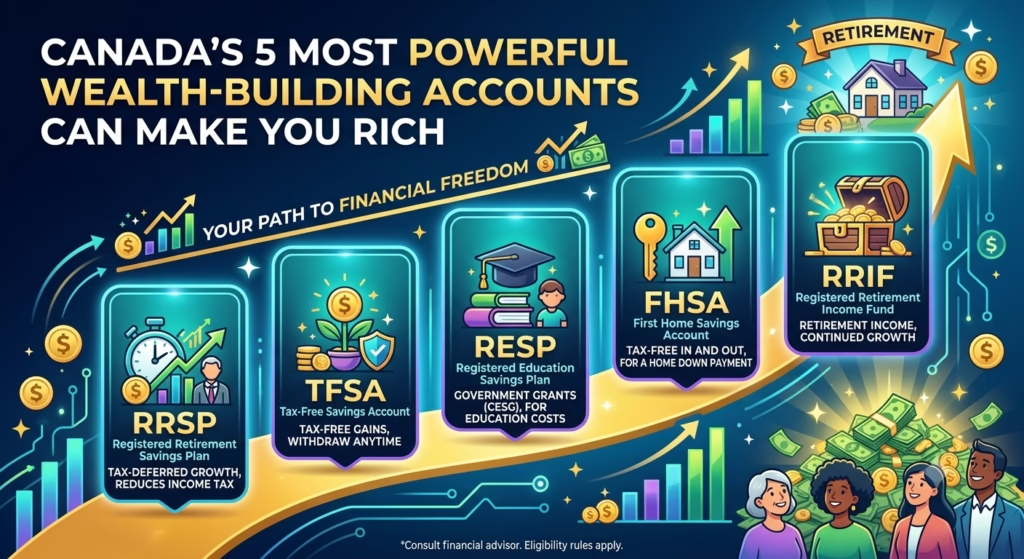
Here is your essential guide to Canada’s five ultimate wealth-building accounts—and how to make them work for you.
The Tax-Free Savings Account (TFSA) suffers from bad branding. It isn’t a traditional bank account for storing emergency cash—it is a high-octane investment vehicle.
1. The TFSA: The Tax-Free Powerhouse
You fund a TFSA with after-tax income, but every cent of interest, dividend income, and capital gain earned inside the account grows 100% tax-free forever. When you withdraw your money, the government takes nothing. Even better: whatever amount you withdraw is added back to your contribution room on January 1st of the following calendar year.
How to maximize it
- The Rules: The annual contribution limit for 2026 is $7,000. If you have been eligible since its inception in 2009 and haven’t contributed yet, your total cumulative room could be as high as $109,000.
- Pro Tip: Skip low-yield savings deposits. Hold broad-market growth ETFs or index funds here to maximize your tax-free compound growth over time.
2. The RRSP: Your Current Income Tax Cut
What it is
The Registered Retirement Savings Plan (RRSP) is designed to help you save for the long haul while giving your current income an immediate tax break.
Why it matters
Contributions to an RRSP are tax-deductible. If you earn $90,000 this year and deposit $10,000 into your RRSP, the CRA taxes you as though you only earned $80,000. Your investments grow tax-deferred until retirement, when you pull the money out—ideally at a time in your life when you are in a significantly lower tax bracket.
How to maximize it
- The Rules: You can contribute up to 18% of your previous year’s earned income, capped at $33,810 for 2026.
- Pro Tip: When your tax refund arrives in the spring, resist the urge to spend it. Reinvest that refund straight back into your RRSP or TFSA to accelerate your portfolio growth.
3. The FHSA: The Ultimate First-Home Cheat Code
What it is
The First Home Savings Account (FHSA) combines the best features of both the RRSP and the TFSA into a single account aimed at aspiring homeowners.
Why it matters
It offers double tax benefits: you get a tax deduction on your contributions (like an RRSP) AND tax-free growth and withdrawals when buying your first home (like a TFSA).
How to maximize it
- The Rules: You can deposit up to $8,000 per year, up to a $40,000 lifetime limit.
- Pro Tip: Open an FHSA even if you aren’t completely sure you’ll purchase a home. If you don’t buy a property within 15 years, you can transfer the entire balance directly into your RRSP without using up any of your existing RRSP contribution room.
4. The RESP: Guaranteed Government Matching
What it is
The Registered Education Savings Plan (RESP) is built to fund post-secondary education for your children or grandchildren.
Why it matters
The federal government directly tops up your contributions through the Canada Education Savings Grant (CESG). They provide an instant 20% match on the first $2,500 you deposit each year. That means you receive a guaranteed 20% return on your money before you even invest it into the market.
How to maximize it
- The Rules: Contribute $2,500 per year per child to unlock the full annual government match of $500, up to a lifetime grant cap of $7,200 per child (with a overall lifetime contribution cap of $50,000 per child).
- Pro Tip: When your child eventually withdraws the funds for school, the gains and grants are taxed in their name—meaning they will likely pay zero tax due to their low student income.
5. Non-Registered Brokerage Accounts: Uncapped Freedom
What it is
A standard, taxable investment account with no special registered status.
Why it matters
While it offers no special tax shelter, it also comes with no contribution limits, no annual caps, and no restrictions on when or how you withdraw your money. While you will pay tax on dividends, interest, and realized capital gains, capital gains are still taxed much more favorably than standard employment income.
How to maximize it
- The Rules: Unlimited contribution space.
- Pro Tip: Move to a non-registered account only after your TFSA, RRSP, and FHSA are fully maxed out. Stick to long-term buy-and-hold index strategies to minimize taxable events along the way.

Quick Summary of Your Tax Buckets
- TFSA: Best for tax-free growth and tax-free withdrawals at any time ($7,000/year cap).
- RRSP: Best for lowering current taxable income while saving for retirement (18% of earned income, up to $33,810 for 2026).
- FHSA: Best for saving for a first home with double tax advantages ($8,000/year up to $40,000 lifetime).
- RESP: Best for getting free government grant money toward your children’s education ($50,000 lifetime cap per child).
- Non-Registered: Best for flexible, unlimited investing once all tax-advantaged accounts are full.
Building real wealth in Canada isn’t about working endlessly—it’s about channeling your income into the right tax-sheltered buckets and letting compound interest do the rest.