

Imagine going to a bank and making a deal: you deposit $100 today, and instead of just handing you pennies in interest, the bank pays you interest on your money. Then next month, they pay you interest on your money plus the interest you earned last month. Then interest on the interest’s interest.
If that sounds like a mathematical snowball rolling down an endless mountain of cash, congratulations—you’ve just met compound growth.
Albert Einstein famously called compound interest the “eighth wonder of the world,” adding that “he who understands it, earns it; he who doesn’t, pays it.” (Looking at you, 22% credit card rates!)
Yet, millions of people skip investing because they think they need a briefcase full of money to get started. The truth? You don’t need a six-figure salary or insider trading tips. All you need is a modest monthly contribution for your investment, a little patience, and the unstoppable physics of compounding.
Here is how small monthly investments transform into life-changing wealth over time.
The Snowball Effect: How Compounding Actually Works
At its core, compound interest is simply growth on top of growth.
When you invest money in broad-market index funds, your capital generates returns (through stock price appreciation and dividends). Instead of pulling those earnings out to buy a shiny new gadget, you reinvest them. Next year, your returns are calculated on a larger base.
Linear Growth (Saving Cash): $200 + $200 + $200 = $600 (Slow & Steady)
Compound Growth (Investing): $200 —> $214 —> $229 —> $245… (Exponential Acceleration)
In the early years, compound growth feels painfully slow. It’s like watching paint dry. But after a decade or two, the curve bends upward, and your investment returns start outearning your actual paycheck.
The Tale of Two Investors: Maya vs. Alex
To see the real magic in action, let’s look at two hypothetical 25-year-olds: Maya and Alex.
- Maya starts investing $250 a month at age 25. She keeps it up until age 35, putting in a total of $30,000 over 10 years, and then never adds another dollar.
- Alex waits until age 35 to get started. He invests $250 a month every single year for 30 years until age 65, contributing a total of $90,000 out of pocket.
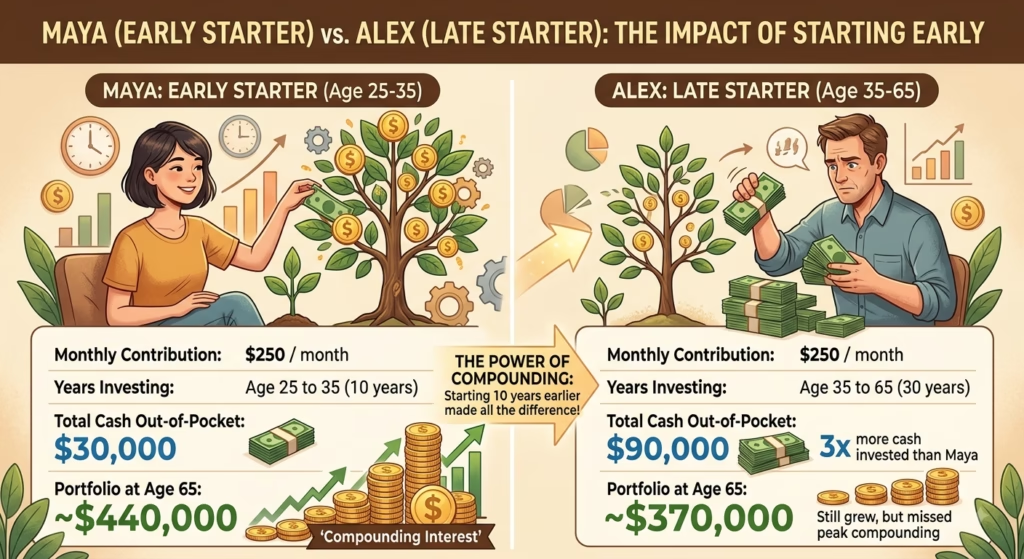
Assuming a standard 8% average annual stock market return, who ends up with more money at age 65?
Even though Alex put in three times as much cash, Maya walks away with significantly more wealth simply because she gave her money ten extra years to compound. Time is the ultimate multiplier.
3 Rules to Supercharge Your Compound Growth Engine
If you want to turn a modest monthly habit into a multi-million-dollar nest egg, follow these simple, battle-tested rules:
1. Start Before You Feel “Ready”
Waiting for the “perfect time” or waiting until you “make more money” is the single most expensive mistake you can make. Investing $50 a month today is far more powerful than waiting five years to invest $200 a month.
2. Automate Everything
Relying on willpower to invest every month is a trap. Set up an automated recurring transfer from your checking account to your investment account (like aTFSA, universal life or whole life) the day after payday. Treat your financial future like a non-negotiable bill.

3. Mute the Market Panic
The stock market goes up, and the stock market goes down. When market downturns happen, resist the urge to panic-sell! For long-term compounders, market dips aren’t disasters—they’re clearance sales on great companies.
The Bottom Line
Building life-changing wealth doesn’t require a stroke of genius, extreme luck, or working 90 hours a week until you collapse. It requires consistency, time, and letting math do the heavy lifting.
Start small, automate your contributions, in TFSA, stay the course, and watch how today’s pocket change turns into tomorrow’s financial freedom!